

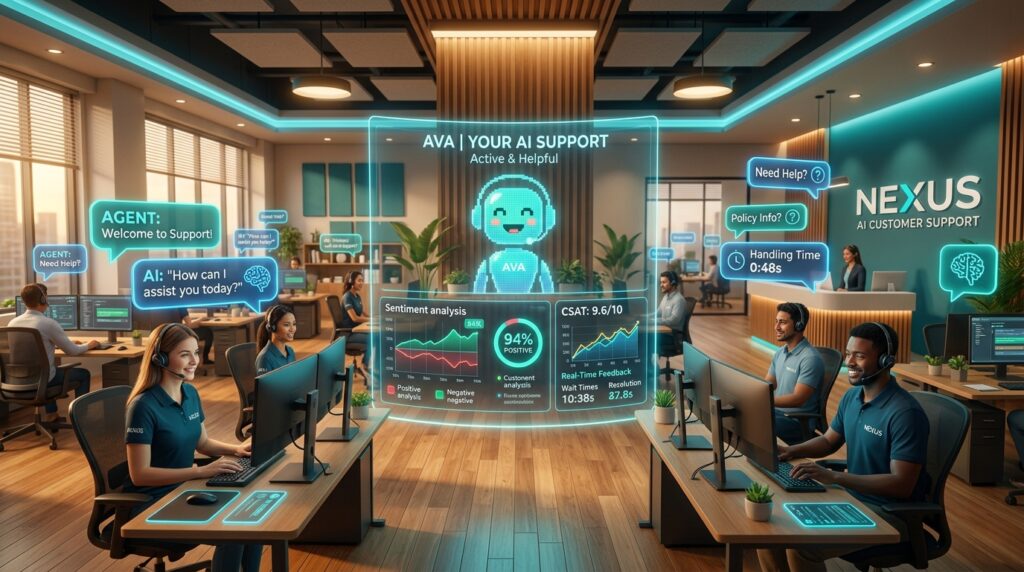
Customer expectations have never been higher. Today’s consumers expect 24/7 support, sub-minute response times, and personalized interactions — at every touchpoint. Meeting these demands with human agents alone is mathematically impossible at scale.
That’s why 63% of businesses now use some form of AI automation in their customer service operations (Salesforce State of Service, 2024). Here’s how it’s changing everything.
The Current State of AI in Customer Service
AI customer service automation has moved well beyond basic FAQ bots. Modern platforms use large language models (LLMs), real-time sentiment analysis, and integration with CRM data to deliver interactions that feel genuinely helpful — not robotic.
Key statistics defining the landscape in 2025:
- 80% of routine support queries are now resolvable by AI without escalation (IBM, 2024)
- AI chatbots handle an average of 2.3 million customer conversations per day at enterprise scale
- Companies using AI support tools see NPS scores improve by 15–20 points on average
- AI-assisted agents resolve issues 52% faster than unassisted agents (Zendesk, 2024)
5 Ways AI Automation Transforms Customer Service
1. Intelligent Chatbots and Virtual Agents
Modern AI chatbots — powered by GPT-4, Claude, or Gemini — can understand context, remember conversation history, and handle multi-step requests. They’re deployed on websites, WhatsApp, SMS, and voice channels simultaneously.
Example: Klarna’s AI assistant handled 2.3 million conversations in its first month, completing work equivalent to 700 full-time agents, with a customer satisfaction score equal to human agents.
2. Intelligent Ticket Routing and Prioritization
AI analyzes incoming support tickets in real time — classifying by topic, urgency, and sentiment — and routes them to the best-qualified human agent. This eliminates manual sorting, which typically wastes 20–30% of agent time.
3. AI-Powered Agent Assist
Rather than replacing agents, AI can support them by suggesting responses in real time, surfacing relevant knowledge base articles, and auto-filling CRM fields. Agents using AI assist tools handle 35% more tickets per day while maintaining higher satisfaction scores.
4. Predictive Support and Proactive Outreach
AI analyzes usage patterns to predict when a customer is likely to encounter a problem — and reaches out proactively. SaaS companies using predictive support see 40% fewer inbound support contacts and significantly higher retention rates.
5. Sentiment Analysis and Escalation Detection
Real-time NLP models monitor customer sentiment throughout a conversation. When frustration signals spike, the system automatically escalates to a human agent — preventing churn before it happens.
Case Study: How Shopify Scaled Support 10x with AI
Shopify grew from 1 million to 4+ million merchants in three years without proportionally scaling its support team. Their AI-powered Sidekick assistant handles inventory questions, billing disputes, and app recommendations autonomously — resolving 74% of tickets without human intervention.
Result: 60% reduction in average handle time, 28% improvement in first-contact resolution, and $120M in estimated annual support cost savings.
Implementing AI Automation in Your Customer Service
- Audit your current ticket volume by category and identify the top 5 most common request types
- Choose a platform: Zendesk AI, Freshdesk Freddy, Intercom, or Tidio for SMBs
- Train your AI on 500+ historical tickets per category for best accuracy
- Deploy in ‘shadow mode’ for 2 weeks — AI responds but agents review before sending
- Go live with full automation on low-risk tiers, human oversight on complex issues
- Measure CSAT, FRT, and resolution rate weekly and retrain monthly
Frequently Asked Questions
Q: Will AI replace human customer service agents?
Not entirely. AI excels at high-volume, repetitive queries (password resets, order status, FAQs) but human agents remain essential for complex problem-solving, emotional conversations, and relationship-building. The future is augmentation, not replacement.
Q: How long does it take to implement AI customer service?
Basic chatbot deployment takes 2–4 weeks. A full AI-assisted support platform with custom training takes 2–3 months. Enterprise implementations with deep CRM integration can take 4–6 months.
Q: What is the ROI of AI customer service automation?
Businesses typically see a 200–400% ROI within 12 months, driven by reduced headcount costs, faster resolution, improved customer retention, and higher CSAT scores that translate to lifetime value improvements.
Conclusion
AI automation in customer service is no longer a futuristic concept — it’s a operational imperative. Businesses that implement it thoughtfully see dramatic improvements in speed, cost, and customer satisfaction simultaneously.
The winning strategy in 2025 is ‘human-in-the-loop AI’ — automating what AI does best while preserving human judgment for what matters most.